
Digital products and services are getting worse – but the trend can be reversed
27. februar, 2026
Digital products and services keep getting worse. A new report from the Norwegian Consumer Council (Forbrukerrådet) shows how this phenomenon – known as enshittification – affects both consumers and society at large, but that it is possible to turn the tide.
– May I speak to a human?
Your Facebook and Instagram feeds are overflowing with scams and fraudulent ads. Your Google searches are being filtered through artificial intelligence, making search results less accurate or outright wrong. You have to pay a subscription fee to remotely heat up your car. Snapchat is demanding money to keep storing your memories. And when you try to complain about your smart speaker that no longer works, you are forced to argue with a chatbot.
– Many people have the feeling that digital services are simply becoming a little bit worse, and it’s not just something you’re imagining. The changes are the result of deliberate choices, as a part of a process called “enshittification”, says Finn Lützow-Holm Myrstad, director of digital policy in the Norwegian Consumer Council.
He continues:
– Enshittification often happens through a myriad of small changes that may, in isolation, seem trivial. Cumulatively, they ruin products and services, exploiting both consumers and third-party businesses in the pursuit of profit. Eventually consumers feel locked in because there are no real alternatives. Digital memories, data, functionality, and even connected devices are being controlled by companies that can make any changes they want, at any time. Many of us end up feeling powerless.
What is enshittification?
“Enshittification” is a term coined by the author and activist Cory Doctorow, which describes the deliberate process of degradation of digital products and services. Enshittification typically happens over several steps:
First, a company offers a service that works well and serves a useful purpose, which leads many people to start using it. The service is often initially provided for free or at an artificially low price, while the company loses money or cross-subsidizes the service.
As the service becomes more popular and indispensable, users become locked in, for example because “it’s where all my friends are”. People can also be locked in through technical means, for example because the service does not allow you to move photos, memories or other information to an alternative service.
After having locked in its users, the service provider starts tightening the screws, first to the advantage of its business customers. For example, they may start undermining your by selling your personal data or placing previously free functionality behind a paid subscription.
You may start seeing more ads, features that gave you control over the user experience are removed, and algorithms are tweaked to increase the amount of sponsored content in your feed. This happens because the service provider knows that you are locked in and cannot easily move to another service.
Finally, when business customers have become locked in because they need to be where their potential customers are, the service provider can start pressuring them as well. For example, the price of placing ads is increased, or businesses must pay to reach audiences that they used to reach organically.
The service provider has thus made both consumers and business customers dependent on the service to a degree that they have no choice but to stay. The price of leaving the platform – or switching cost – is simply too high, for consumers, advertisers or other businesses that rely on the platform to live their lives, keep in touch with friends and family, conduct their business, etc.
The service provider and its shareholders are left holding all the profits, at the cost of everyone else.
«Too big to care»
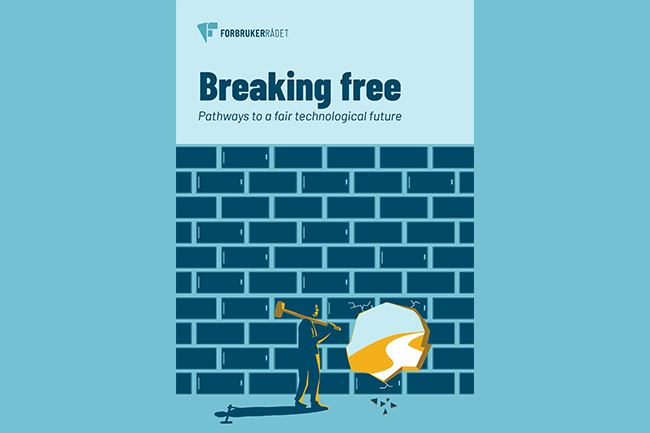
In the new report Breaking Free: Pathways to a fair technological future, the Norwegian Consumer Council has delved into enshittification and how to resist it. The report also shows how and why enshittification has become the norm for Big Tech companies.
Myrstad refers to Meta as an example, the owner of services such as Facebook, Instagram and WhatsApp. According to Reuters, Meta estimates that ten percent of the company’s annual revenue comes from fraudulent ads on its services – amounting to a dizzying 16 billion dollars.
– Meta is earning billions from consumers being scammed. Even if the company gets fined – a process that takes years – the fines we have seen so far only amount to a fraction of these profits. In other words, Meta has no incentive to solve the problem. Meanwhile, the company doesn’t lift a finger to help its users, whether their profiles are misused in the scam ads, or they fall victim to the scams, Myrstad says.
– It’s not too late!
The ongoing enshittification trend is not inevitable; luckily for us, enshittification is not a natural law, Myrstad emphasises:

– Technology must work for people. We must take power from the large digital platforms and give it back to users, innovators, and society. It’s not too late to turn the tide. Technology can be a power for innovation and societal good, but only if we make sure that it serves us, not just the largest companies.
In the report, the Consumer Council suggests concrete measures to help rebalance power between consumers and digital service providers:
- Stronger rights for consumers to control, adapt, repair, and alter their products and services,
- Interoperability, data portability, and decentralisation as the norm, so the threshold for moving to different services becomes as low as possible,
- Deterrent and vigorous enforcement of competition law, so that Big Tech companies are not allowed to indiscriminately acquire start-ups, competitors or otherwise steer the market to their advantage,
- Better financing of initiatives to build, maintain or improve alternative digital services and infrastructure based on open source code and open protocols,
- Reduce public sector dependence on big tech, to regain control and to contribute to a functioning market for service providers that respect fundamental rights,
- Deterrent and consistent enforcement of other laws, including consumer and data protection law.
Joint international campaign
Therefore, the Norwegian Consumer Council and 58 organisations and experts are sending a letter to the Norwegian government, asking for rebalancing of power between consumers and service providers, that the public sector prioritises services based on open source code and protocols in procurement procedures, and that sufficient resources are allocated to enforcement authorities dealing with big tech.
Our sister organisations are sending similar letters to their own governments in 12 countries. In addition, we are sending a letter to the European Commission, together with 29 civil society organisations such as the European consumer organisation BEUC, Amnesty International, European digital rights (EDRi), the Trans Atlantic Consumer Dialogue (TACD) and many more. In this letter we call for reducing dependency on big tech and warn about the risks of deregulation.
Consumer Federation of America, EPIC – Electronic Privacy Inforomation Center, National Association of Consumer Advocates and Public Citizen sent the following letter to select US policy makers.

Andreas Framnes
Kommunikasjonsrådgiver – mat og helse